Rubber Pool Deck vs. Pavers vs. Travertine
When resurfacing or building a pool deck with a luxury finish, many homeowners who know about upscale rubberized overlays end up comparing them to pavers and travertine. All three have strengths in the right situation. Here’s how rubber compares to these more industry-standard finishes across several key considerations.
Weeds, Sand, and Ants — Rubberized Wins
Pavers and travertine are both installed piece by piece, which means every deck made from them has seams. Over time, those seams invite weeds, sand, and ants close to the home. Rubberized overlays work differently — they’re poured in place, hand-troweled as a continuous slurry that fills every seam, crack, and imperfection in the existing deck. The result is a completely seamless surface with no gaps for weeds or pests to move into.
Travertine does hold up somewhat better than pavers here, since travertine stones are typically larger than standard pavers and create fewer seams — but the problem never fully goes away. It’s a perennial issue with any surface that relies on joints. We frequently get requests to install directly over existing pavers for this exact reason: weeds, sand, and ants, whether as individual complaints or, more often, all three at once. This often isn’t a first consideration for our snowbirds, many of whom are still new to Florida and haven’t yet seen how quickly nature reclaims an outdoor space here.
Initial Cost Comparison — Depends (Usually Pavers Win)
Price comparisons between these materials are difficult, since rubber, pavers, and travertine can each span a wide range of prices. For this exercise, let’s assume a Resilion rubberized overlay compared to a mid-grade paver and a mid-grade (often called “select grade”) travertine. In this case, Resilion typically falls between the cost of pavers and travertine — at least at first. Price differences between pavers and Resilion often shrink over time, thanks to Resilion’s lower maintenance needs. Pavers can also come with their own installation complications — for example, needing to lift the pool cage to accommodate the added thickness of a paver system, which can make installation wildly more complex and costly than expected.
Long-Term Cost Comparison — Rubberized Wins
Due to the low-maintenance performance of a high-grade rubber like Resilion, ownership and maintenance costs over time favor Resilion.
Lifestyle — Rubberized Wins
Rubberized overlays are the clear winner here, by a wide margin. Between the safety, underfoot feel, low-impact installation, and low-maintenance performance, this isn’t simply a beauty product — it’s a lifestyle foundation. One of the most immediate differences homeowners notice is texture underfoot: rubber offers a slight cushioned feel that traditional hard surfaces don’t. For families who spend a lot of time barefoot around the pool, that difference matters daily.
Cleanability — Rubberized Wins
With one caveat: make sure your rubberized deck is certified to be pressure-washable, like the Resilion system. The cleanability win for rubberized decks comes from an important Catch-22 of pavers and travertine. With joint-based systems, when you try to pressure wash them to remove dirt and weeds, the sand blows out of the joints. Without that silica sand, the joints become more vulnerable to weeds and movement, so they need to be re-sanded. It’s a constant battle of cleaning versus maintenance.
Natural Look — Travertine Wins
There’s no escaping the natural beauty of travertine. It’s a genuine natural stone, not a manufactured paver made to imitate one, so it brings real texture and variation that’s difficult to replicate. Rubber can be modern, upscale, and seamless, but it isn’t natural — so while it complements most architecture, it can stand out against a historical home, like a 1920s Spanish Revival.
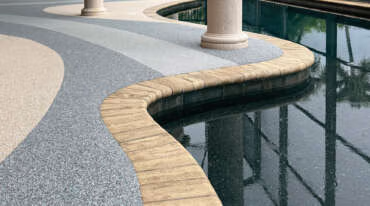
For clients who love the look of travertine but are also drawn to everything rubber does better, we’ve found a great compromise. Travertine can be used just for the pool coping, where it’s grouted rather than jointed with loose sand — so it won’t introduce weeds — while a rubberized overlay covers the rest of the pool surround. [link: 26th Place] With this approach, the natural stone stays visible right where the eye is drawn, at the coping, while the rest of the deck stays comfortable to walk, lounge, and live on.
Underfoot Temperature — Rubberized and Some Travertine Win
Rubber feels remarkably cool to the touch compared to most competing products in a similar color, putting it on par with standard-grade travertine or Cool Deck surfaces. Standard-grade travertine does get points for underfoot coolness, but it’s also the lowest grade of travertine — meaning it demands more maintenance and is structurally weaker than higher grades.
That said, any surface — whether natural stone or rubber — can get hot if installed in a dark color. We recommend getting a sample of your preferred color and leaving it on the hottest part of your deck, since underfoot temperature is highly color-dependent.
Repairability — Pavers and Travertine Win
Rubberized overlays, when installed to a high standard, are highly repairable — much more so than stamped concrete or spray crete — and repairs are often invisible. But there’s no match for pavers or travertine when it comes to repairability. Simply lift the tile and put in a new one.
Which Surface Fits Your Backyard?
- Choose travertine if the natural stone look matters more to you than avoiding weeds or maximizing slip safety.
- Choose pavers if you want a classic-looking upgrade over builder-grade concrete at a lower cost than travertine. Be prepared for weeding.
- Choose rubberized overlays if you want your deck to be the foundation of a comfortable, low-maintenance outdoor living lifestyle.